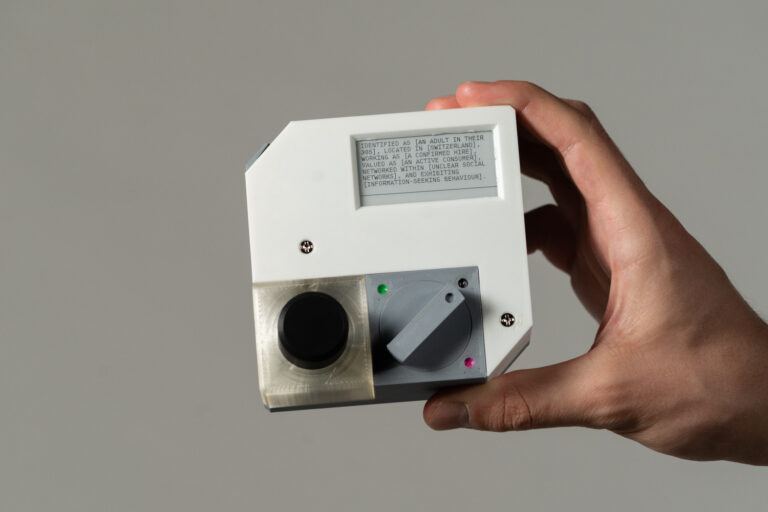
알레시아 라 로카(Alessia La Rocca)가 SUPSI(인터랙션 디자인 예술학 석사 과정)에서 제작한 레플리카(Replica)는 알고리즘이 구축한 나의 데이터 프로필을 눈으로 보고, 손으로 만지고, 직접 바꿀 수 있는 형태로 변환합니다. 다양한 플랫폼 위에 존재하는 '또 다른 나'를 내 손으로 조작할 수 있게 해주는 작품입니다.
검색어 하나, 페이지 방문 하나. 우리의 모든 디지털 행동은 우리도 모르는 사이 알고리즘 프로필로 쌓여갑니다. 이 프로필은 채용 심사나 신용 평가처럼 현실의 기회를 좌우하는 데 쓰이지만, 정작 당사자는 동의는커녕 그 존재조차 알지 못합니다. '데이터 도플갱어(Data Double)'라 불리는 이 프로필은 단편적인 행동 데이터들을 교차 분석해 만들어집니다. 각각의 데이터는 별것 아닌 것처럼 보이지만, 조합되는 순간 보이지 않는 문지기가 되어 사용자가 깨닫기 훨씬 전부터 그의 삶에 영향을 미칩니다.
알레시아 라 로카(Alessia La Rocca)
레플리카(Replica)는 이 데이터 도플갱어를 눈에 보이고 직접 다룰 수 있는 것으로 만드는 생태계입니다. Chrome 확장 프로그램이 사용자의 브라우징 행동을 조용히 관찰하며 인구통계, 지리, 직업, 경제, 사회문화, 심리행동의 여섯 가지 범주로 분류합니다. 단순한 탐색 기록이 하나의 '알고리즘 문장'으로 변환되어, 시스템이 이 사용자를 어떤 사람으로 판단하는지를 일상적인 언어로 보여줍니다. 함께 제공되는 대시보드는 이렇게 추론된 정체성을 더 깊이 들여다볼 수 있게 해줍니다. 각 데이터 포인트의 비중, 수집 시점, 전파 경로를 시각화하고, 맥락 이탈의 순간—건강 관련 검색이 보험 위험 점수에 반영되는 것처럼, 한 맥락에서 수집된 데이터가 전혀 다른 목적으로 활용되는 순간—도 명확히 짚어냅니다.
Replica_ Mod 01은 이 시스템의 첫 번째 물리적 장치로, 디지털 노동자들을 위해 설계되었습니다. 연결된 플랫폼에 하루 종일 의존하며 살아가는 이들은 눈에 보이지 않는 프로파일링에 가장 많이 노출된 사람들이기도 합니다. 이 오브제는 책상 위에 조용하고 묵묵하게 자리를 지키며, e-잉크 스크린에는 오직 하나의 문장만을 표시합니다. 다른 어떤 인터페이스도 없습니다. 두 개의 로터리 엔코더는 서로 상반된 두 가지 제스처를 통해 사용자에게 통제권을 돌려줍니다. 하나는 '포이즈닝(poisoning)'으로, 특정 카테고리에 노이즈를 주입해 알고리즘의 추론을 무너뜨리고 사용자를 분류 불가능한 존재로 만드는 것입니다. 다른 하나는 '앰플리파잉(amplifying)'으로, 특정 신호를 의도적으로 강화하는 방식입니다. 두 동작 모두 오직 이 오브제 위에서만 이루어지며, 화면과는 무관합니다. 자신의 알고리즘적 정체성을 되찾는 일이 무심코 클릭 한 번으로 끝나는 게 아니라, 의식적이고 물리적인 행위로 남도록 하기 위해서입니다.
기기의 주요 마이크로컨트롤러로는 Arduino Nano ESP32를 사용하며, 로컬 WiFi HTTP 서버와 OTA 업데이트를 지원합니다. 문장 렌더링에는 Waveshare 2.13인치 e-ink 디스플레이(GxEPD2 드라이버)를 탑재했습니다. EC11 로터리 인코더 두 개(그중 하나는 푸시 버튼 포함)로 카테고리 탐색과 동작 선택을 처리하고, RGB LED로 주변 피드백을 제공합니다. 전원부는 TP4056 충전 모듈, 단셀 LiPo 배터리, MT3608 부스트 컨버터, USB-C 브레이크아웃 보드로 구성되며, 이 모든 요소를 직접 3D 프린팅한 케이스 안에 담았습니다. 펌웨어는 Arduino/ESP32 코어 기반의 C++로 작성되었으며, GxEPD2, Adafruit GFX(커스텀 IBM Plex Mono 비트맵 폰트 포함), ArduinoJson, WiFi/WebServer, ArduinoOTA 라이브러리를 활용했습니다. Chrome Manifest V3 확장 프로그램은 사용자의 브라우징 활동을 백그라운드에서 자동으로 여섯 가지 데이터 카테고리로 분류하는데, 이를 위해 자체 제작한 키워드·시그널 분류기를 사용해 '알고리즘 문장'을 생성합니다. 확장 프로그램과 기기는 로컬 HTTP를 통해 통신하며, 확장 프로그램과 대시보드는 콘텐츠 스크립트 브리지 방식으로 연결해 Manifest V3 서비스 워커의 문제를 우회합니다. 대시보드는 GitHub Pages에 호스팅된 정적 HTML/CSS/JavaScript 웹앱으로, 전용 토큰과 서체(Aeonik, Aeonik Mono)를 적용한 커스텀 디자인 시스템 위에 구축되었습니다.
Created by Alessia La Rocca at SUPSI (Master of Arts in Interaction Design), Replica turns your algorithmic data profile into something you can see, touch, and reshape — letting you manipulate the versions of yourself that live on different platforms. Every digital action, from a search query to a page visit, silently feeds an algorithmic profile that shapes real-world opportunities, from job screening to credit access, without awareness or consent. This profile, known as the Data Double, is built by cross-referencing fragments of behavior that appear harmless in isolation, and it operates as an invisible gatekeeper long before the user is ever aware of its existence. Alessia La Rocca Replica is an ecosystem that makes this data double visible and actionable. A Chrome extension passively observes browsing behaviour and classifies it into six categories, bio-demographic, geographic, professional, economic, socio-cultural and psycho-behavioural, translating raw navigation into a single "algorithmic sentence" that describes, in plain language, who the system believes the user to be. A companion dashboard reconstructs this inferred identity in more depth, showing the weight, age and propagation of each data point, and flagging moments of decontextualisation, when data collected in one context is exploited in another, such as a health search feeding an insurance risk score. Replica_ Mod 01 , the first physical device in the system, is designed for digital workers, individuals whose daily reliance on connected platforms makes them especially exposed to this invisible profiling. It sits on the desk as a quiet, ever-present object, its e-ink screen displaying only the sentence, with no interface to distract from it. Two rotary encoders return control through two opposing gestures: poisoning, which injects noise into a chosen category until the inference collapses and the user becomes unclassifiable, and amplifying, which reinforces a chosen signal to intentionally strengthen it. Both actions live exclusively on the object, never on the screen, so that reclaiming one's algorithmic identity remains a deliberate, physical act rather than another distracted click. The device uses Arduino Nano ESP32 as main microcontroller, running a local WiFi HTTP server and OTA updates. Waveshare 2.13 e-ink display (GxEPD2 driver) for the sentence rendering. Two EC11 rotary encoders (one with push button) for category navigation and action selection. RGB LED for ambient feedback. Power chain with TP4056 charger, single-cell LiPo battery, MT3608 boost converter and USB-C breakout, all in a custom 3D-printed enclosure. Firmware is written in C++ on the Arduino/ESP32 core. Libraries include GxEPD2, Adafruit GFX (with a custom IBM Plex Mono bitmap font), ArduinoJson, WiFi/WebServer, ArduinoOTA. Chrome Manifest V3 extension that passively classifies browsing activity into six data categories via a custom keyword/signal classifier, generating the "algorithmic sentence." Extension and device communicate over local HTTP. Extension and dashboard communicate through a content-script bridge, avoiding Manifest V3 service worker issues. Dashboard is static HTML/CSS/JavaScript webapp hosted on GitHub Pages, built on a custom design system with dedicated tokens and typefaces (Aeonik, Aeonik Mono). Project Page | Alessia La Rocca | SUPSI