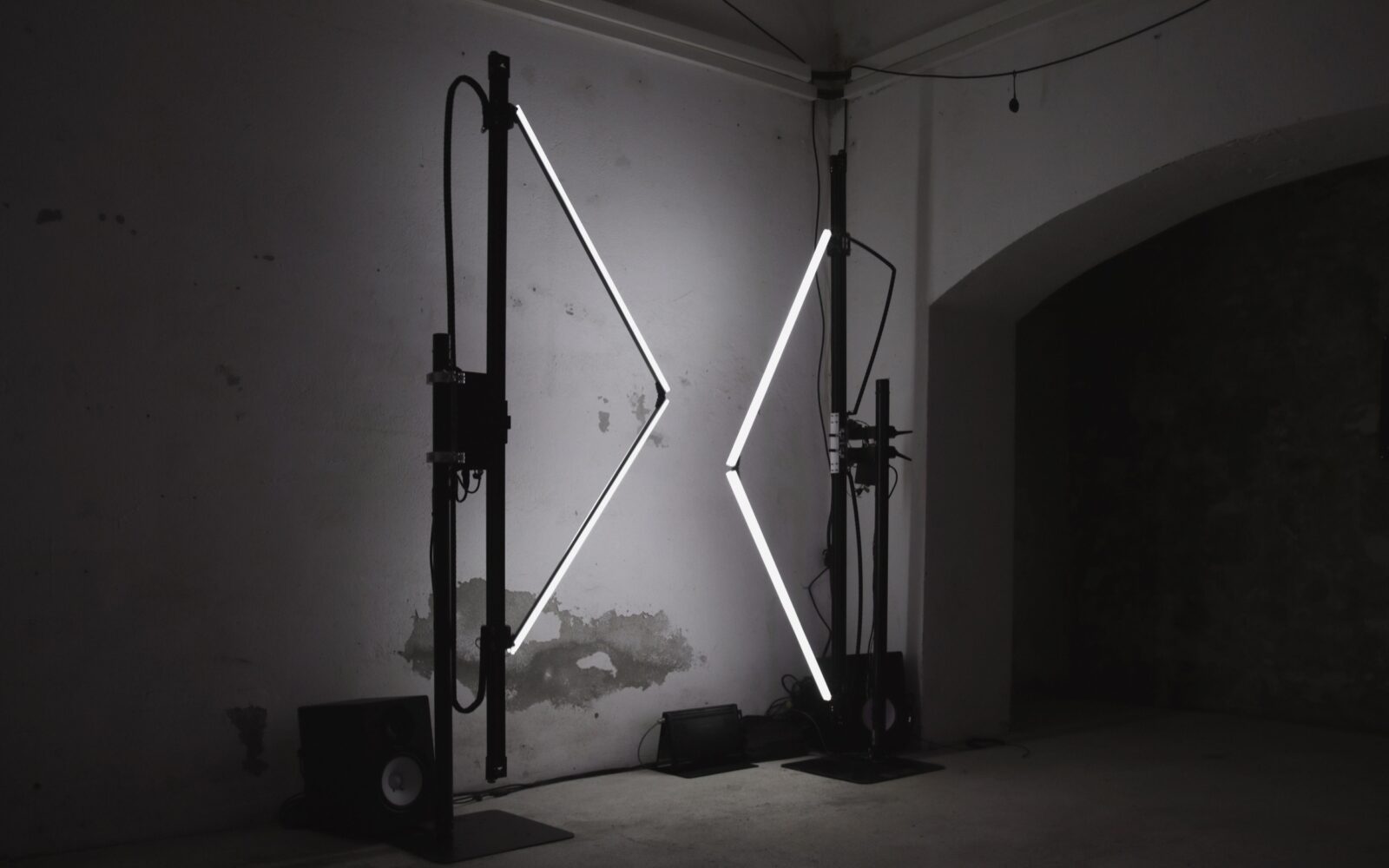
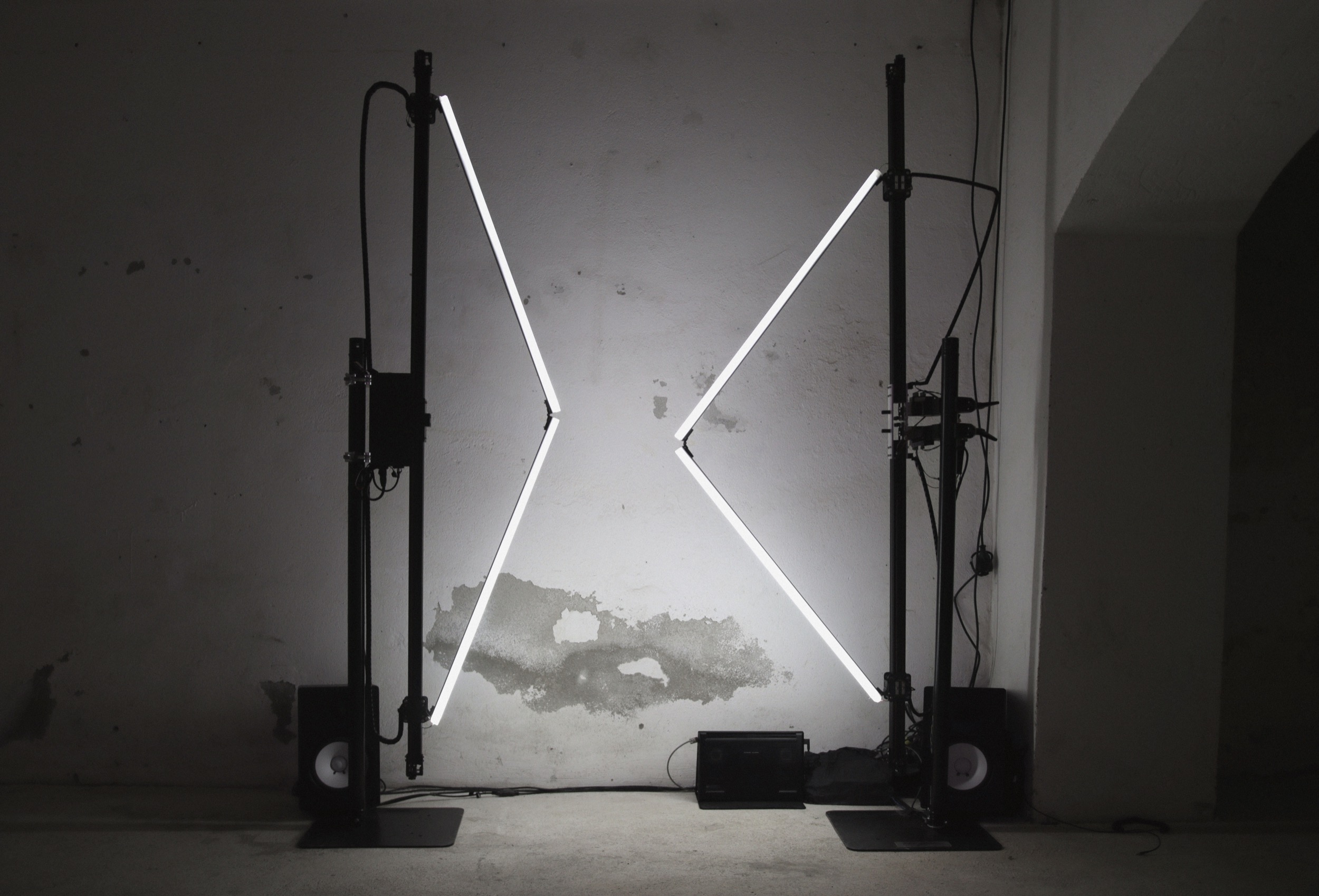
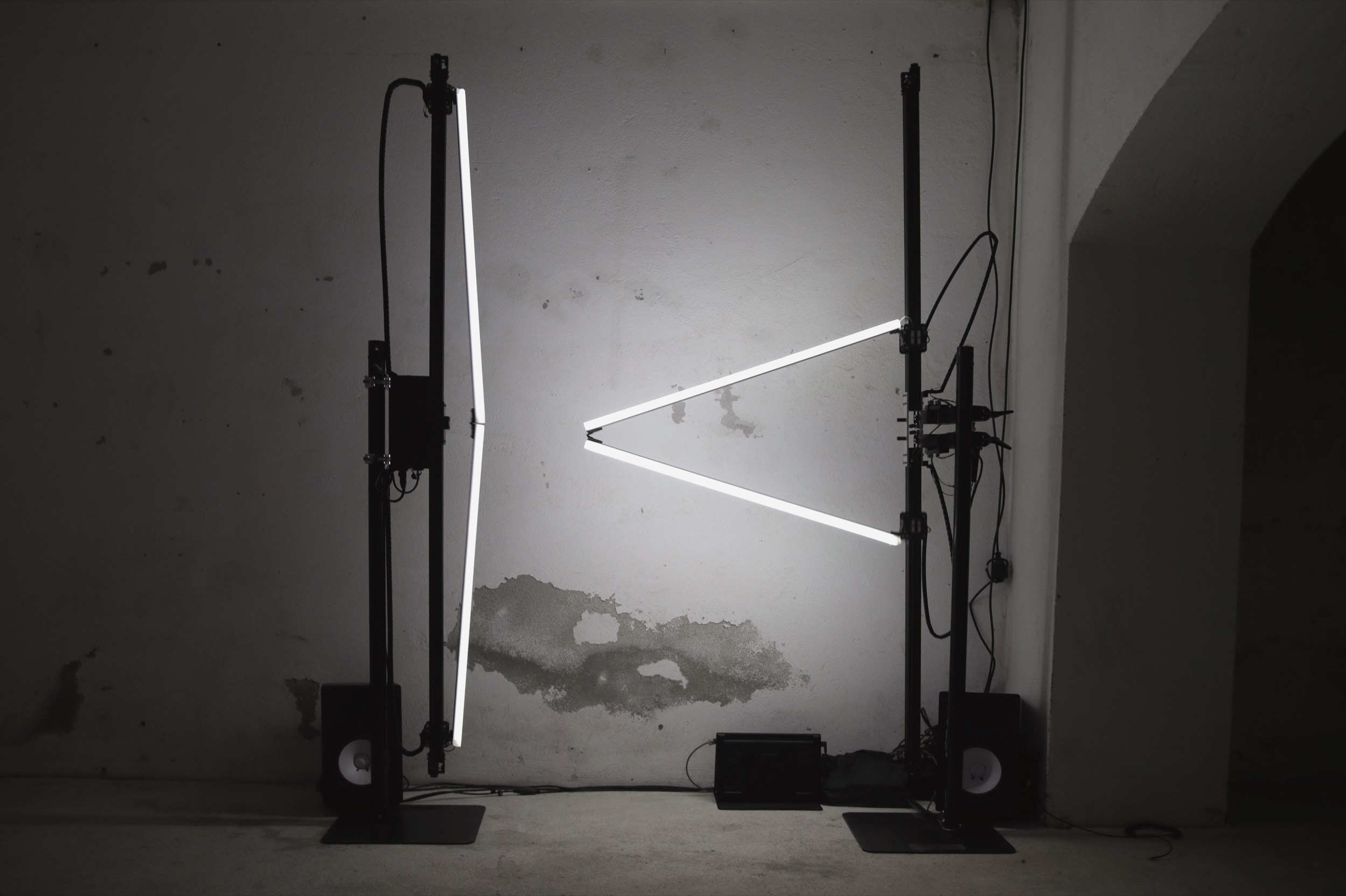
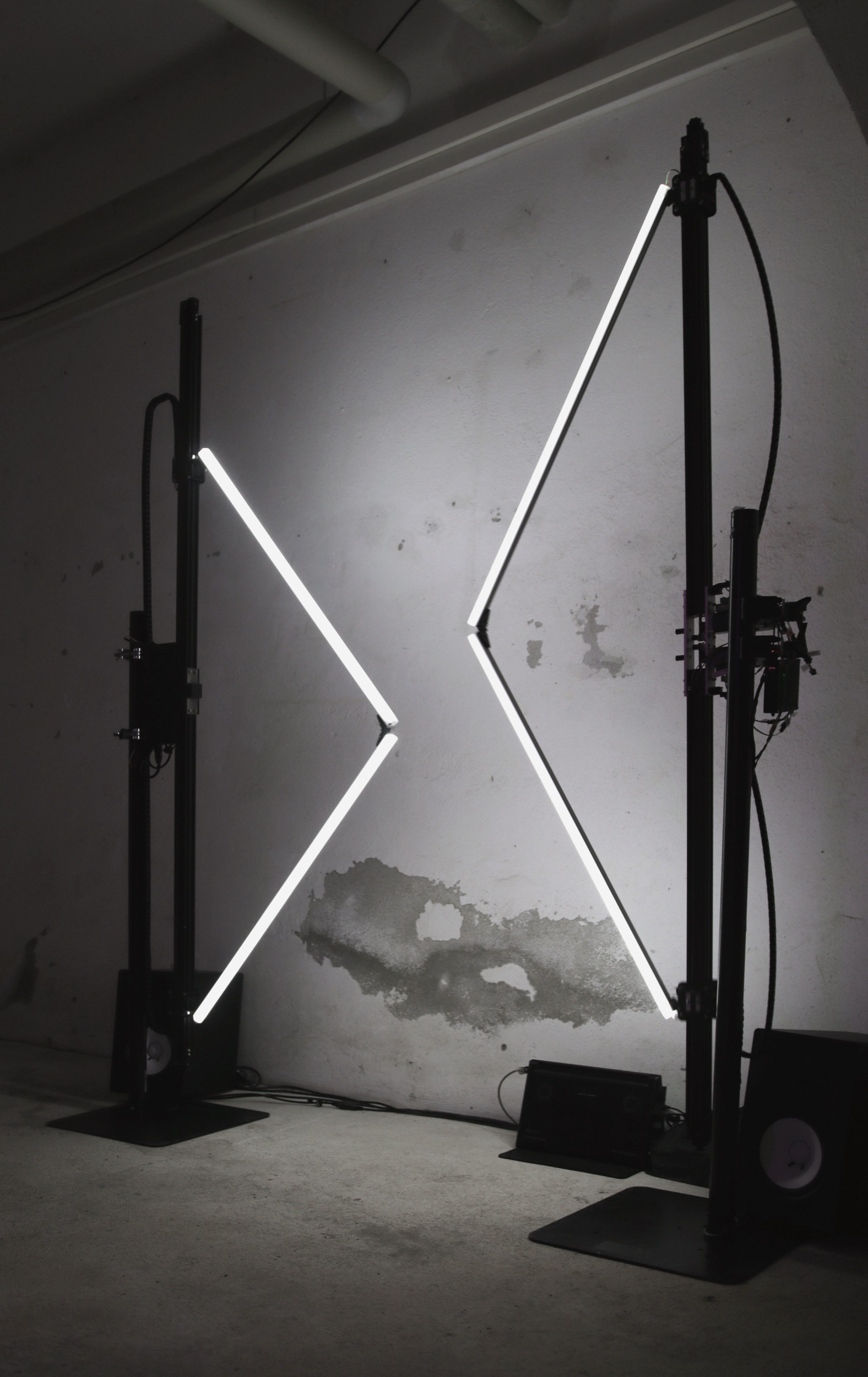
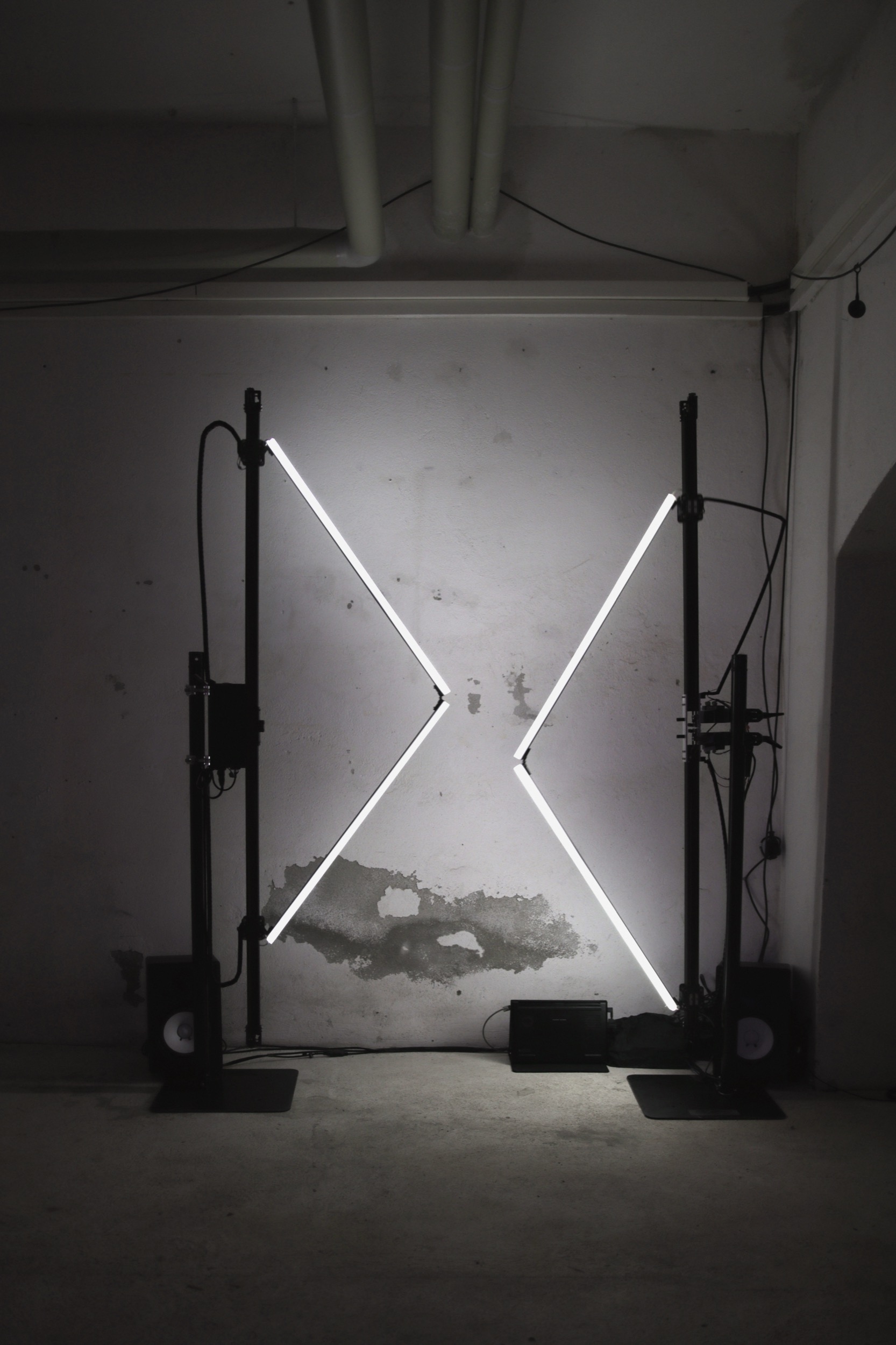
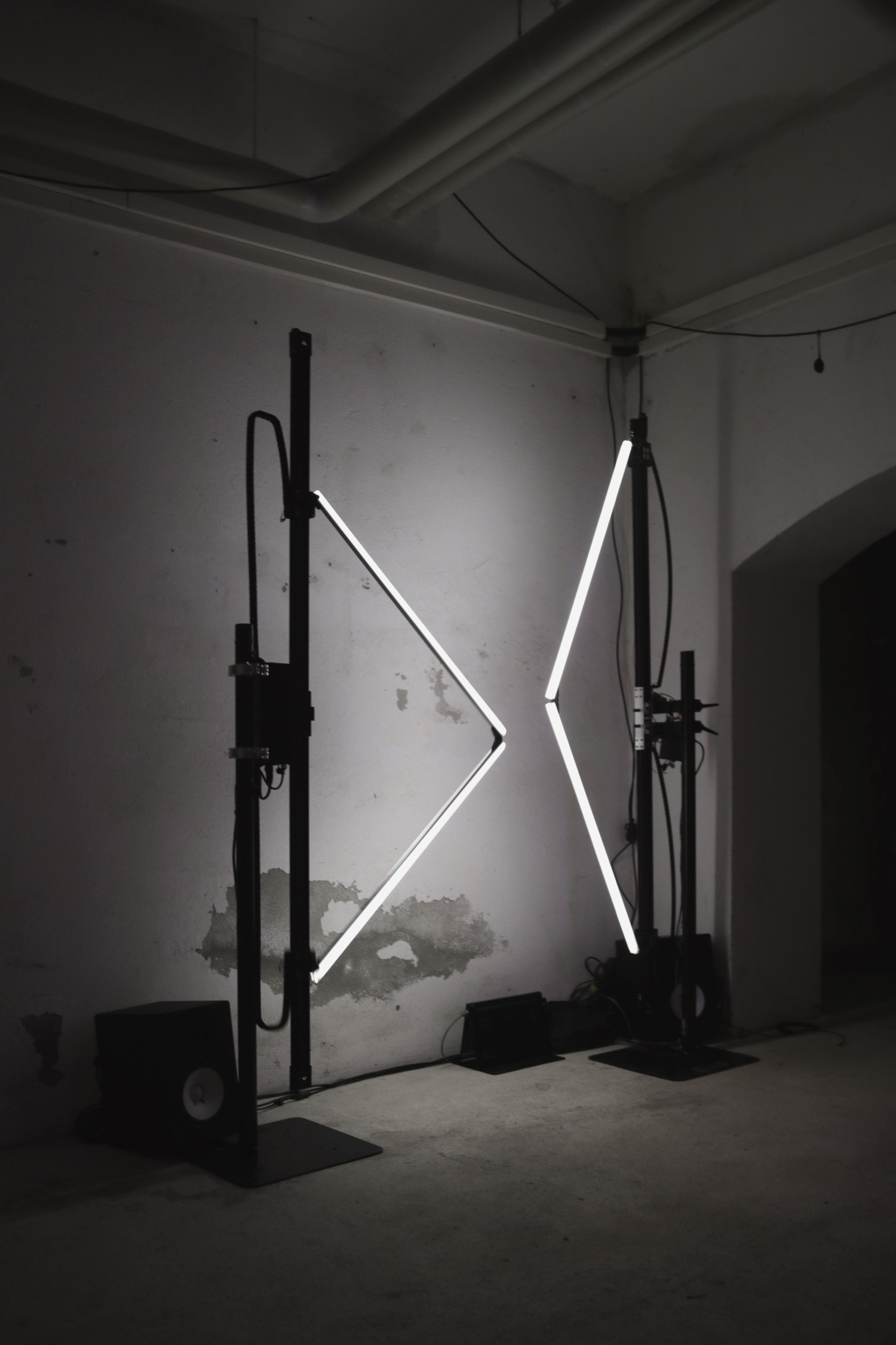
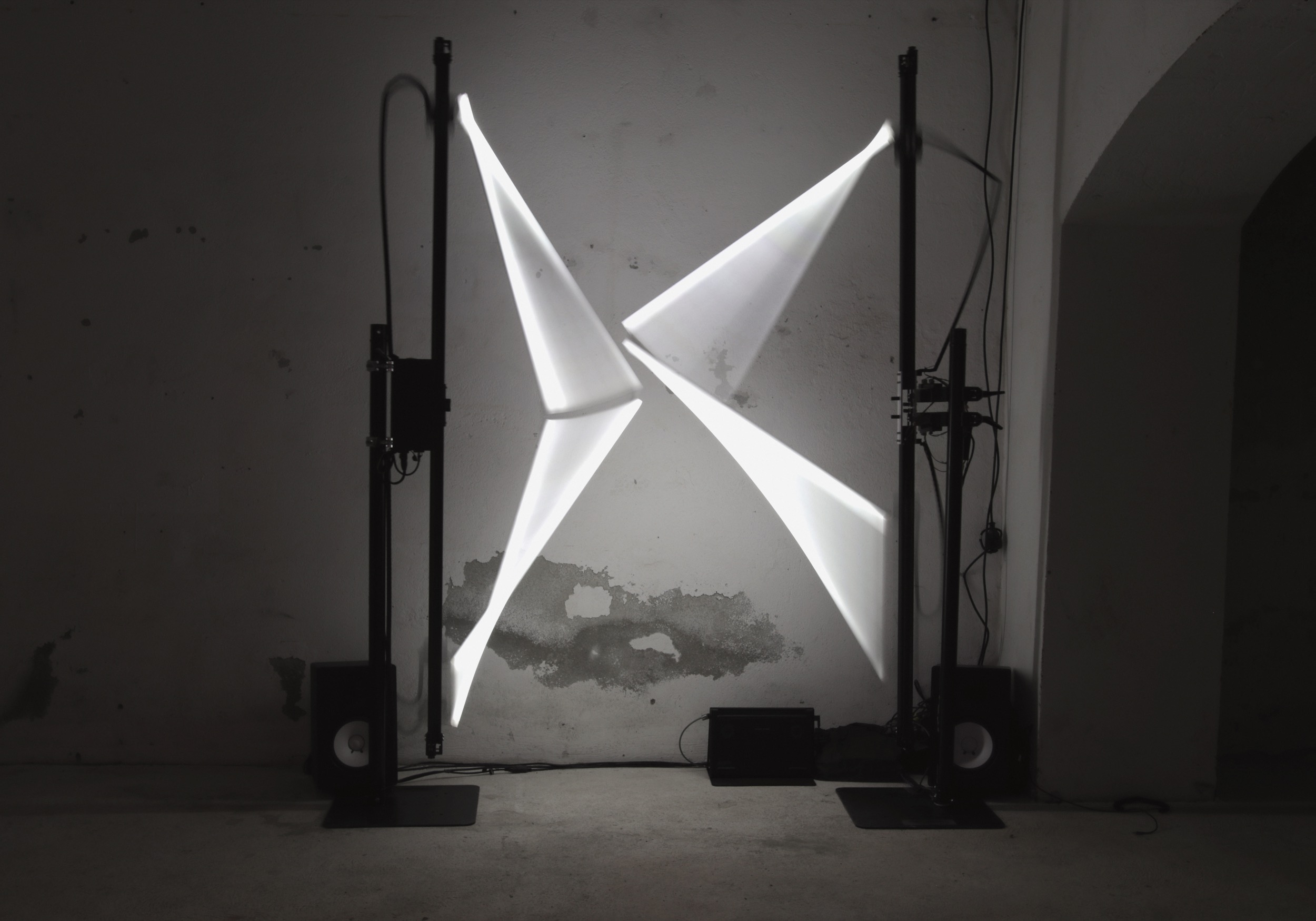
비컴 앤 브레이크(Become and Break)는 현재 진행 중인 시청각 키네틱 라이트 조각 프로젝트입니다. 컴퓨터의 도움을 받는 퍼포머들이 앙상블을 이루며 펼치는 알고리즘 안무 속에서, 개인과 사회의 리듬이 어떻게 드러나는지를 탐구합니다. 이 프로젝트는 우리가 현실과 맺는 관계가 끊임없이 변화한다는 관찰에서 출발합니다. 열정과 소진 사이, 소속감과 고립감 사이, 그리고 일의 흐름에 몸을 맡기는 순간과 그 흐름 속에서 길을 잃는 순간 사이에서.
여기서 '컴퓨터의 도움을 받는 퍼포머'란, 인간의 의도와 기계의 실행이 맞닿는 지점에서 표현이 탄생하는 기계 배우를 뜻합니다. 각 퍼포머는 관절로 연결된 두 개의 1미터짜리 LED 세그먼트로 구성되며, 서보 모터로 구동됩니다. 이들은 단순하면서도 서로 맞물린 파라미터들로 조직된, 생성적이고 비선형적인 알고리즘 안무를 따릅니다. 시스템은 이 파라미터들을 바탕으로 모터의 속도와 위치를 조절하고, 퍼포머들 사이의 공간과 각각의 밝기, 빛의 움직임을 빚어냅니다. 사운드는 설치 작품의 기계 소음을 녹음한 것에서 출발해, 즉각적으로 잘리고, 반복되고, 느려지고, 빨라집니다. 이처럼 서로 연동된 변화들이 작품의 리듬을 만들어내고, 퍼포머들 사이의 관계를 읽는 방식을 끊임없이 바꿔놓습니다.
이 작품은 다양한 구성을 탐구하는 시리즈의 첫 번째로, 두 명의 퍼포머, 즉 한 쌍의 관계에 초점을 맞춥니다. 단순한 움직임의 규칙과 공간적 제약이 이들의 행동을 형성하고, 그 안에서 긴장이 통제된 관계가 만들어집니다. 언제라도 닿을 듯하지만, 결코 닿지 않는 관계. 친밀함과 반발이 교차하는 이 리듬은, 우리가 타인과의 관계 속에서, 그리고 주변의 제약 속에서 끊임없이 스스로를 조율해 나가는 방식을 추상적인 이미지로 담아냅니다.
이 프로젝트는 팀 아우징어(Tim Auzinger)와 다니엘 바어(Daniel Baer)가 함께 개발했습니다. 다니엘은 전기기계 엔지니어링을, 팀은 프로그래밍과 전기 프로토타이핑, 아트 디렉션을 담당하지만, 두 사람의 역할은 의도적으로 유동적으로 유지됩니다. 이 작업은 서로 겹치는 관심사와 공유된 지식, 그리고 긴밀한 협업 위에서 만들어집니다.
비컴 앤 브레이크(Become and Break) I는 두 대의 맞춤 제작 기계 퍼포머로 구성된 시청각 키네틱 설치 작품입니다. 각 퍼포머는 관절로 연결된 1미터짜리 어드레서블 RGBW LED 세그먼트 두 개로 이루어지며, 서보 모터가 이를 직선 방향으로 움직입니다. LED 세그먼트의 양 끝은 3D 프린팅된 나일론-카본 슬레드에 고정되어 있으며, 이 슬레드가 벨트 드라이브를 통해 알루미늄 V-슬롯 프로파일을 따라 이동하면서 구조 전체가 경첩처럼 열리고 닫히는 움직임을 만들어냅니다.
각 퍼포머는 ESP32 마이크로컨트롤러로 제어됩니다. Visual Studio Code의 PlatformIO 환경에서 Arduino 프레임워크를 기반으로 개발된 커스텀 소프트웨어가 구동되며, 모터 제어에는 요헨 키에메스(Jochen Kiemes)의 FastAccelStepper, LED 제어에는 마이클 C. 밀러(Michael C. Miller)의 NeoPixelBus 라이브러리를 주로 활용했습니다. 컨트롤러는 이더넷으로 연결되어 E1.31(이더넷 기반 DMX) 프로토콜을 통해 색상과 위치 데이터를 실시간으로 수신합니다. ESP32의 듀얼 코어 구조를 활용해 데이터 수신 처리와 LED·모터 제어를 각각의 코어에 분리함으로써 안정적인 동작을 구현했습니다.
제어 데이터는 TouchDesigner로 구축한 커스텀 안무 시스템이 실시간으로 생성합니다. 이 시스템은 주파수 기반의 흑백 이미지 애니메이션을 움직임과 조명 모두의 근간으로 삼습니다. 주파수, 위상, 블렌딩 같은 파라미터는 규칙 기반 피드백 시스템에 의해 끊임없이 변조되며, 픽셀 매핑을 통해 산출된 이미지 데이터는 모터 위치와 LED 값으로 변환됩니다. 두 퍼포머 간의 물리적 충돌을 방지하기 위한 상호 의존 관계도 별도의 처리 과정을 통해 설정됩니다. 최종 데이터는 E1.31 프로토콜을 통해 ESP32 컨트롤러로, OSC를 통해 Ableton Live 12로 각각 전송됩니다.
사운드는 설치 작품의 기계 장치와 모터에서 실제로 발생하는 소음을 스테레오로 녹음한 것에서 출발합니다. 이 녹음본은 Ableton Live 내부 플러그인으로 구동되는 VCV Rack 2 기반의 생성형 샘플 시스템으로 가공됩니다. 짧은 음향 조각들을 무작위로 선택해 겹치고, 늘이고, 지연시키는 방식은 비주얼 시스템의 변조 프로세스와 맞닿아 있습니다. 또한 특정 음향 이벤트가 트리거를 생성해 안무 시스템으로 다시 전송되며, LED 밝기 같은 파라미터에도 영향을 미칩니다.
개발 과정에서는 하드웨어, 소프트웨어, 사운드를 오가며 반복적으로 프로토타입을 제작했습니다. 실제 설치물에 적용하기 전, Unreal Engine으로 구축한 디지털 시뮬레이션 환경에서 두 퍼포머 간의 움직임과 상호작용을 먼저 테스트했습니다.
사용 도구 및 기술: ESP32, Arduino framework, PlatformIO, Visual Studio Code, TouchDesigner, Ableton Live 12, VCV Rack 2, Unreal Engine, FastAccelStepper, NeoPixelBus, E1.31, OSC, 이더넷 네트워킹, 3D 프린팅, 알루미늄 V슬롯 프로파일, 벨트 드라이브 메커니즘, 서보 모터, 어드레서블 RGBW LED.
Become and Break is an ongoing project of audiovisual kinetic light sculptures. We explore how personal and social rhythms may be discovered in the algorithmic choreographies of an ensemble of computer-aided performers. The project grows from our observations of how our relationship to reality constantly shifts: between enthusiasm and exhaustion, belonging and isolation; between flowing with the rhythm of work and getting lost in it. By computer-aided performers, we mean machine actors whose expression emerges from the relation between human intention and machine execution. Each performer consists of two one-meter LED segments connected by joints and driven by servo motors. They follow a generative, non-linear, algorithmic choreography organized through simple, interdependent parameters. Based on these parameters, the system modulates motor speed and position, shaping the space between the performers as well as each one’s brightness and light animations. The sound is derived from recordings of the installation’s mechanical noise and is responsively cut, looped, slowed down, and accelerated. These interdependent shifts shape the work’s rhythm and alter how the relations between the performers may be read. This is the first work in an ongoing series using different arrangements. Here, the focus is on two performers: a couple. Their behavior is shaped by simple movement rules and spatial constraints, creating a relationship of controlled tension—always about to touch, yet never doing so. This rhythm of intimacy and repulsion becomes an abstract image of how we continuously adjust ourselves in relation to others and to the constraints around us. The project is developed by Tim Auzinger and Daniel Baer . Daniel’s focus lies in electromechanical engineering, while Tim focuses on programming, electrical prototyping, and artistic direction. Their roles remain deliberately fluid, and the project draws from overlapping interests, shared knowledge, and close collaboration. Become and Break I is an audiovisual kinetic installation consisting of two custom-built machine performers. Each performer is made from two one-meter addressable RGBW LED segments connected by articulated joints and moved linearly by servo motors. The endpoints of the LED segments are mounted on 3D-printed nylon-carbon sleds that travel along aluminium V-slot profiles via belt drive, allowing the structures to open and close in a hinge-like motion. Each performer is controlled by an ESP32 microcontroller running custom software developed with the Arduino framework using PlatformIO in Visual Studio Code. The main libraries used are FastAccelStepper by Jochen Kiemes for motor control and NeoPixelBus by Michael C. Miller for LED control. The controllers are connected via Ethernet and receive real-time color and position data using E1.31 ( DMX over Ethernet). The ESP32’s two cores are used to separate incoming data handling from LED and motor control. The control data is generated live by a custom choreographic system built in TouchDesigner . This system uses frequency-based black-and-white image animations as the basis for both movement and light. Parameters such as frequency, phase, and blending are continuously modulated by a rule-based feedback system. Through pixel mapping, the resulting image data is translated into motor positions and LED values. Additional processing establishes a dependency between the two performers in order to prevent physical collision. The final data is sent via E1.31 to the ESP32 controllers and via OSC to Ableton Live 12 . The sound component is based on stereo recordings of the installation’s own mechanical and motor noises. These recordings are processed in a generative sample system built in VCV Rack 2, running as a plugin inside Ableton Live. Short sound fragments are randomly selected, layered, stretched, and delayed in ways that parallel the modulation processes used in the visual system. Distinct sonic events also generate triggers that are sent back to the choreographic system, influencing parameters such as LED brightness. During development, the project was prototyped iteratively across hardware, software, and sound. A digital simulation in Unreal Engine was also used to test behaviors and interactions between the two performers before applying them to the physical installation. Project Page | Tim Auzinger | Daniel Baer Tools, frameworks, and technologies used: ESP32, Arduino framework, PlatformIO, Visual Studio Code, TouchDesigner, Ableton Live 12, VCV Rack 2, Unreal Engine, FastAccelStepper, NeoPixelBus, E1.31, OSC, Ethernet networking, 3D printing, aluminium V-slot profiles, belt drive mechanics, servo motors, addressable RGBW LEDs.