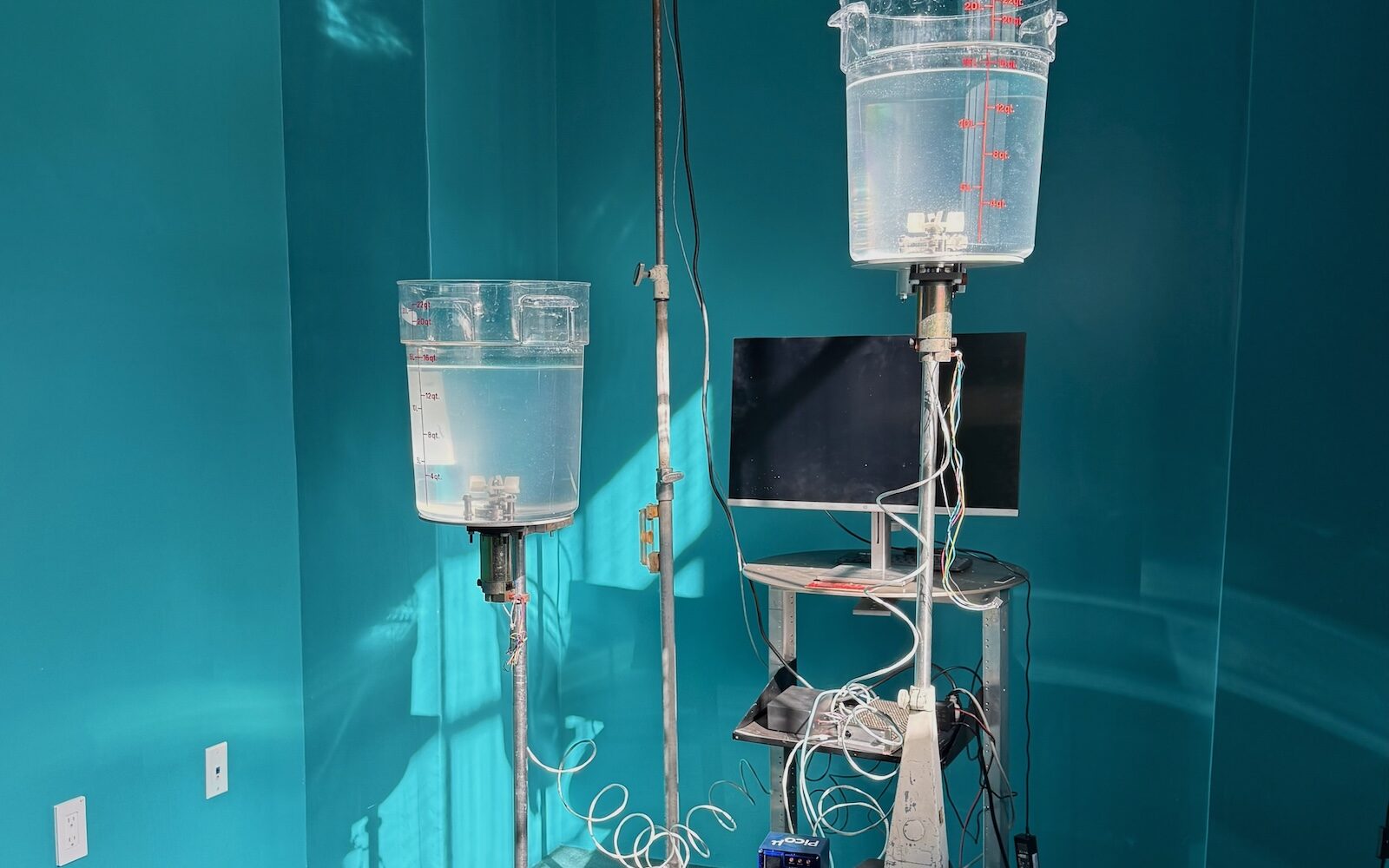
바니 헤인스(Barney Haynes)가 제작한 뮤온/보텍스(Muon/Vortex)는 우주에서 날아오는 입자인 뮤온을 활용한 조각 시스템입니다. 심우주에서 무작위로 도달하는 뮤온이 감지기를 작동시키고, 감지기는 물이 담긴 두 개의 용기 속에 소용돌이를 일으킵니다. 뮤온이 드문드문 도착할 때는 수면이 잔잔하게 가라앉아 거울처럼 빛을 반사하고, 연속으로 몰려올 때는 물결이 거세지며 흐름 속에 물결무늬와 골이 새겨집니다.
저는 뮤온/보텍스를 기계와 우연을 결합한 긴 예술의 계보 위에 놓인 작품으로 생각합니다. 핵심적인 영감의 원천은 다다이스트 시인 트리스탄 차라(Tristan Tzara)입니다. 모자(혹은 주머니)에서 무작위로 단어를 꺼내 시를 만드는 방식으로 유명했던 그에게 우연은 결함이 아니라 협력자였습니다. 세계 스스로가 말을 걸어오는 통로이자, 시인이 인위적으로 부여할 수 있는 어떤 질서보다 깊고 솔직한 진실을 드러내는 방법이었죠. 차라가 사용한 재료는 언어였고 그의 '기계'는 단순한 용기에 불과했지만, 뮤온/보텍스는 그 몸짓을 한 단계 더 밀어붙입니다. 잘게 자른 단어 조각 대신, 대기를 통과해 내려오는 입자의 도착에 반응하는 것입니다. 이 작품에서 아티스트의 역할은 구성하는 것이 아니라 듣는 것입니다. 우주가 텍스트를 제공하고, 감지기가 이를 번역하며, 물의 소용돌이가 그것에 목소리를 부여합니다.
바니 헤인스(Barney Haynes)
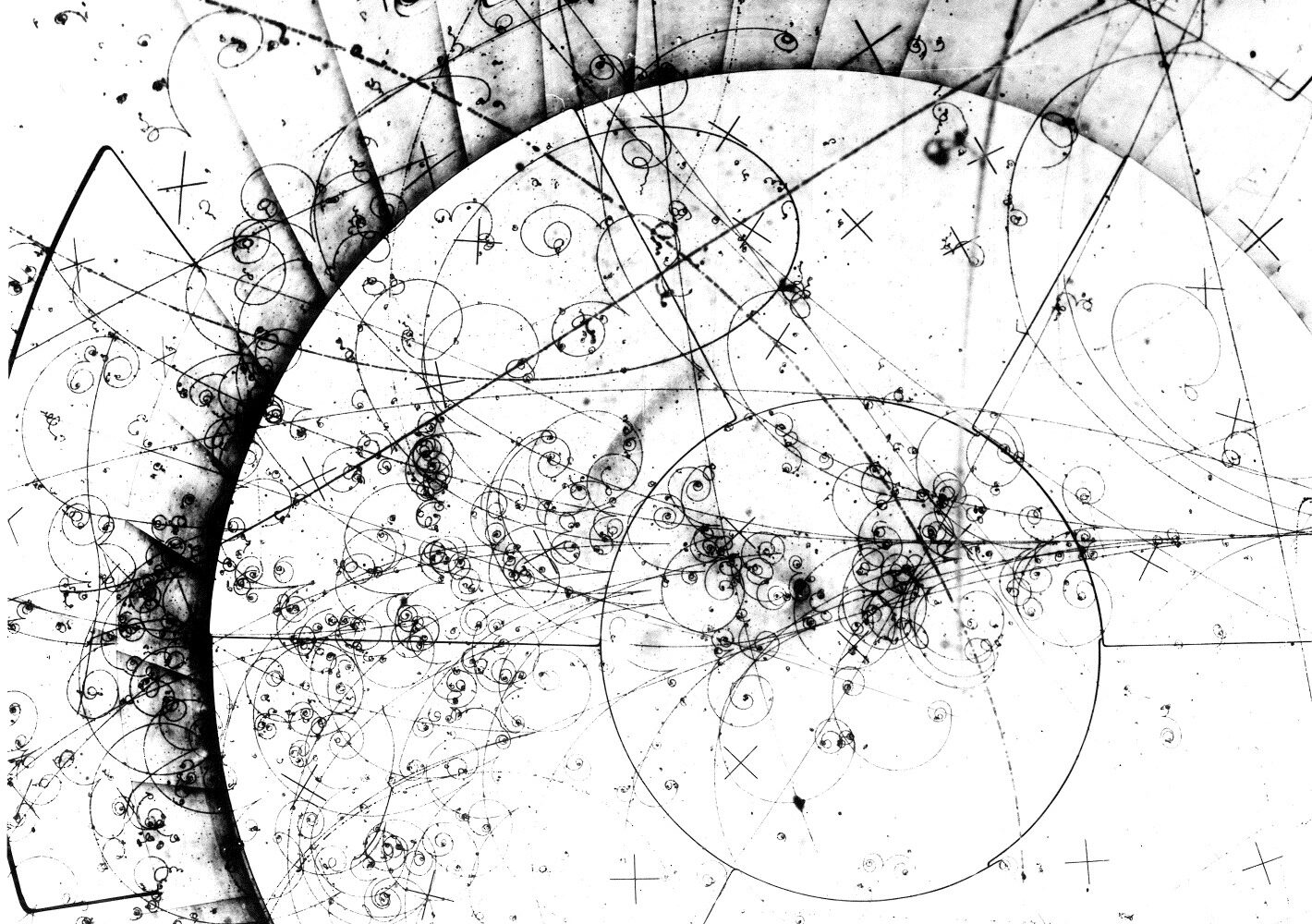
“입자 충돌(Particle Collisions)” CERN 문서 서버
우주에서 지구 표면까지 도달하는 다른 입자들과 달리, 뮤온을 검출하는 데는 값비싼 장비가 필요하지 않습니다. 가이거 튜브(Geiger tubes)와 동시 계수 회로를 조합한 DIY 장치로도 충분히 감지할 수 있습니다. 뮤온/보텍스(Muon/Vortex)는 비교적 단순한 방식으로 뮤온을 포착합니다. 두 개의 섬광체를 층층이 쌓은 구조입니다. 뮤온이 섬광체를 통과하면 내부 전자를 자극해 아주 짧은 빛의 섬광이 발생합니다. 불과 수십억 분의 1초에 불과한 순간이지만, 이를 감지하는 것은 가능합니다. 두 섬광체가 동시에 반응할 때, 우리는 뮤온이 통과했다고 판단할 수 있습니다. 배경 방사선이라면 첫 번째 섬광체에서 이미 차단되었을 것이기 때문입니다.
아래의 시각화 작업은 바니(Barney)의 스튜디오에서 실시간으로 검출되는 뮤온 신호에 반응합니다. 화면 속 주요 궤적이 뮤온이며, 기호 μ로 표시됩니다. 뮤온의 도착은 거품 상자 사진(bubble chamber photography) 기법의 시각 언어로 표현됩니다. 이는 20세기 중반에 개발된 기술로, 아원자 입자의 충돌을 우아한 곡선 궤적으로 포착해냈습니다. 뮤온의 경로 주변으로 이차 입자들이 호를 그리며 소용돌이치고, 그 형태는 매 검출 순간의 에너지에 따라 달라집니다.
이 작품은 우연을 하나의 물질적 힘으로 구현하며, 우주적 시간과 인간의 몸이 느끼는 경험 사이의 조용한 교감을 드러냅니다. 설치 작품은 어떤 과업을 수행하는 기계라기보다, 눈에 보이지 않는 힘이 흔적을 남길 수 있는 하나의 상황에 가깝습니다. 수백만 년을 가로질러 온 에너지가 잠시 물 위에 자신을 새겨넣고, 이내 다시 사라집니다.
Created by Barney Haynes , Muon/Vortex is a sculptural system in which cosmic particles called muons, arriving randomly from deep space, activate a detector, which in turn activates vortexes in two water-filled containers. Extended pauses between the muons' arrival allow the water's surface to settle into reflective calm, while clustered arrivals drive turbulence that carves ribs and channels through the flow. I imagine Muon/Vortex as participating in a long lineage of artworks incorporating machines (considered broadly) and chance. The Dadaist poet Tristan Tzara, known for creating poems by pulling random words from a hat (or his pocket), is a key influence. Chance for him was a collaborator, not a flaw—a portal through which the world itself could speak, and reveal a deeper and more honest order than anything the poet could impose. Although the elements Tzara used were linguistic and his "machine" a simple container, Muon/Vortex extends his gesture. Instead of a bag of cut-up words, it responds to the arrival of atmospheric particles. In Muon/Vortex, the artist's job is not to compose but to listen. The universe provides the text; a detector translates it; the water vortex gives it voice. Barney Haynes "Particle Collisions" CERN Document Server Unlike other kinds of particles that reach the Earth's surface from space, muons don't require expensive equipment to detect them. Indeed, they can be detected using a DIY mashup of Geiger tubes and coincidence circuits. Muon/Vortex detects muons via a relatively simple apparatus, namely two stacked scintillators. When a muon passes through a scintillator, it excites electrons in the material, producing a tiny flash of light (lasting only billionths of a second, but still detectable). When both scintillators fire simultaneously, we know that a muon has passed through, as opposed to background radiation, which would have been stopped by its interaction with the first scintillator it encountered. The visualization below responds in real time to muon detections in Barney's studio. The dominant trace is the muon, which is identified by the symbol μ. Its arrival is rendered in the style of bubble chamber photography, the mid-century technique that made subatomic collisions visible as elegant curving tracks. Secondary particles arc and spiral around the muon's path, their geometry shaped by the energy of each detection. The work renders chance as a material force, revealing a quiet correspondence between cosmic time and embodied experience. The installation becomes less a machine performing a task than a situation in which unseen forces are allowed to leave a trace. Energy that has traveled for millions of years briefly inscribes itself into water before vanishing again. Project Page | Barney Haynes MATERIALS & SYSTEMS Detection PicoMuon cosmic-ray detector (UK Radio Astronomy Association) Computation Raspberry Pi 5 microcomputer Software openFrameworks (open-source C++ environment) Actuation Dual-channel 6–24V, 10A DC motor driver Motors Gearless Pittman Lo-Cog 24 VDC motors Coupling Custom magnetic couplers (hybrid-manufactured) Fluid Interfaces 3D-printed impellers Structure Aluminum and stainless steel, polycarbonate vessels, bearings, shafts, nylon fasteners AI tools Claude, ChatGPT Web p5.js, Node.js, nginx, WebSockets