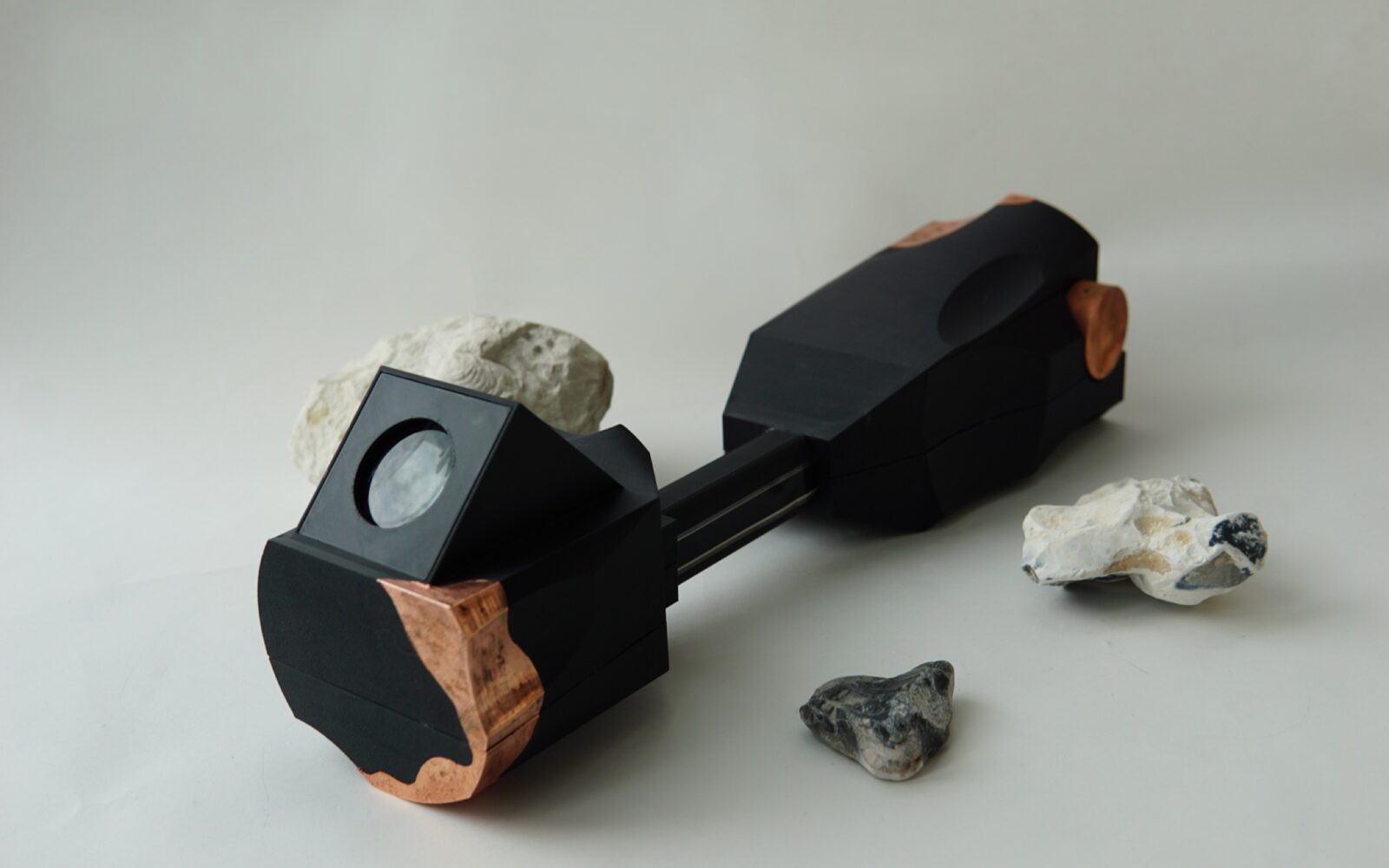
Conditions of Appearance는 디지털 정보가 어떻게 등장하고, 사라지고, 우리의 주의를 끄는지를 탐구하는 인터랙티브 디자인 프로젝트입니다. DICE Lamp와 NET Compass, 두 개의 인터랙티브 오브제로 구성된 이 작업은 온라인 정보의 불안정한 속성을 신체적이고 물질적이며 의례적인 경험으로 변환합니다.
우리가 디지털 콘텐츠를 소비하는 일상 속에서, 전쟁과 재난의 뉴스, 짧은 영상, 밈, 개인 메시지는 모두 같은 화면 위에 펼쳐집니다. 스크롤과 스와이프라는 동일한 손짓으로 도달하고, 거의 같은 시각적 무게를 지닙니다. 모든 것은 스크롤되고, 모든 것은 대체됩니다. 이 프로젝트는 묻습니다. 디지털 정보는 어떤 종류의 주의를 받아 마땅한가? 아무런 노력 없이 모든 것이 도달할 때, 우리는 무엇을 잃는가?
이 작업은 '디지털 모노노아와레(digital mono no aware)'라는 개념을 통해 전개됩니다. 일본의 미학 개념인 모노노아와레(物の哀れ), 즉 무상함에 대한 감수성, 그리고 사물이 영원하지 않기에 오히려 우리를 움직인다는 사유에서 출발합니다. 디지털 미디어의 맥락에서, 하나의 헤드라인, 짧은 영상, 속보 이미지는 몇 초 동안 나타났다가 다음 콘텐츠에 묻혀버립니다. 삭제되는 것이 아닙니다. 밀려나고, 잊혀지는 것입니다.
이 프로젝트는 의도적인 부조리함을 품은 채 질문을 던집니다.
우리가 지는 꽃잎을 애도하듯, 사라지는 헤드라인을 애도할 수 있다면 어떨까요? 화면 위의 모든 것이 그런 주의를 받을 자격이 없다면, 과연 무엇이 자격을 가질까요? 같은 속도로, 같은 피드를 통해, 같은 스와이프로 모든 것이 도달할 때, 우리는 어떻게 그 차이를 알아챌 수 있을까요?
NET Compass는 실시간 온라인 뉴스를 방향, 거리, 압력으로 변환하는 장치입니다. 뉴스 API에 실시간으로 연결해 최신 헤드라인을 불러오고, 각 사건이 발생한 위치를 사용자의 현재 물리적 위치와 대응시킵니다. 뉴스를 평면 화면 속 텍스트로 보여주는 대신, 나침반 방위각, 수직 기울기, 압력 기반 인터랙션으로 정보를 번역해냅니다.
NET Compass
뉴스를 탐색할 때 사용자는 사건이 일어난, 혹은 일어나고 있는 방향으로 몸을 돌립니다. 수평으로 회전하면 방위각에 따라 검색이 이루어지고, 수직으로 기울이면 거리를 조절할 수 있습니다. 기기를 아래로 향하면 가까운 지역 뉴스가, 위로 들어 올리면 더 먼 곳의 소식이 펼쳐집니다. 예를 들어 런던에서 북우크라이나의 분쟁을 찾는다면, 기기를 대략 동북동 방향으로 향한 채 위쪽으로 기울이게 됩니다. 처음 접하는 시점에는 지명이 표시되지 않기 때문에, 사용자는 텍스트만으로 위치를 파악할 수 없습니다. 대신 방향 감각과 몸의 움직임에 의존해야 합니다. 더 자세한 내용을 읽으려면, 기기를 안정적으로 잡은 상태에서 손잡이를 쥐어야 합니다. 살짝 쥐면 느리고 단편적인 텍스트가 나타나고, 더 세게 쥘수록 내용이 풍부해지고 표시 속도도 빨라집니다. 방향이 조금만 바뀌어도 다른 기사가 나타나고, 원래 방향으로 되돌아간다고 해서 이전 기사가 다시 나타나리라는 보장도 없습니다. 정보는 그냥 주어지지 않습니다. 몸을 쓴 만큼만 얻을 수 있습니다.
DICE Lamp은 스위치를 누르면 불이 켜진다는 당연한 공식을 뒤흔듭니다. 조명은 보통 가장 단순한 형태의 일상적 통제입니다. 스위치를 누르면 불이 켜지죠. 하지만 이 작품에서 버튼을 누르면 작은 OLED 디스플레이에 디지털 주사위 애니메이션이 펼쳐집니다. 주사위가 6이 나와야만 불이 켜집니다. 켜짐과 꺼짐이라는 익숙한 이진법적 논리가 깨지는 순간입니다. 아무것도 보장되지 않습니다. 불을 켜는 단순한 행위조차도요.
DICE Lamp
두 오브제의 재료적 언어는 개념적 토대를 더욱 단단하게 만들어줍니다. 일부 표면에는 구리 전기주조와 산화 처리를 적용해, 공기와 시간, 손길에 따라 조금씩 변해가는 마감을 구현했습니다. 구리 표면에는 세월의 흔적과 다루어진 자국, 접촉의 기억이 고스란히 남아, 매끄럽고 마찰 없는 현대 전자기기의 디자인 언어와 의도적인 대비를 이룹니다. 형태는 시든 연꽃과 괴석(怪石)을 참조하는데, 이는 동아시아 미술에서 무상함과 시간의 흐름, 그리고 모노노아와레(物の哀れ)와 연결되는 모티프입니다.
두 오브제는 함께, 상호작용이란 언제나 매끄럽고 힘이 들지 않아야 한다는 통념에 의문을 던집니다. 하나는 무언가가 '나타난다'는 것이 과연 어떤 의미인지를 묻고, 다른 하나는 나타난 것과 함께 머문다는 것이 무엇을 요구하는지를 묻습니다. 이 프로젝트는 디지털 정보가 아무리 찰나적이고 가상적인 것이라 해도, 그 나름의 무게를 지닐 수 있다고 말합니다. 그저 우리를 스쳐 지나가는 것과 우리를 붙잡아 두는 것을 어떻게 구별할 수 있을지, 그리고 그 구별을 스스로 해낼 수 있으려면 어떤 만남의 조건이 필요한지를 묻는 작업입니다.
NET Compass는 WiFi를 통해 실시간 뉴스 API에 연결되는 네트워크 기반 인터랙티브 기기입니다. 전원을 켜면 ESP32 마이크로컨트롤러가 WiFi에 접속하고, 일정 간격으로 API에 쿼리를 보내 현재 사건들의 헤드라인, 설명, 지리적 좌표가 담긴 JSON 데이터를 수신합니다. 펌웨어는 사용자의 위치에서 각 사건까지의 나침반 방위각을 계산하고, 사용자가 실제로 바라보는 방향과 가장 가까운 결과를 매칭합니다. MPU6050 자이로스코프로 읽어들인 기울기 각도는 지리적 검색 반경을 결정합니다. 아래로 기울이면 주변 지역 사건을, 위로 기울이면 전국 및 글로벌 범위로 검색이 확장됩니다. FSR 센서에 가해지는 쥐는 압력은 OLED 화면에 표시되는 텍스트가 한 글자씩 나타나는 속도를 조절합니다. DICE Lamp는 버튼을 누를 때마다 마이크로컨트롤러가 무작위 결과를 생성합니다. 결과는 작은 OLED 화면에 주사위 애니메이션 시퀀스로 표시되며, 내부 LED는 결과가 6일 때만 켜집니다. 나머지 경우에는 램프가 꺼진 채로 남고, 다음 시도를 위해 인터랙션이 초기화됩니다. 두 오브제의 주요 구조물은 모두 PLA 소재로 FDM 3D 프린팅으로 제작되었으며, DICE Lamp의 갓은 반투명한 질감을 위해 PETG 소재로 출력했습니다.
Conditions of Appearance는 피지컬 컴퓨팅, 임베디드 전자공학, 실시간 네트워크 데이터, 3D 프린팅, 소재 실험을 하나로 엮은 작업입니다. 두 오브제 모두 완전히 작동하는 인터랙티브 프로토타입으로 개발되었습니다.
ESP32 — 메이커용 마이크로컨트롤러 (WiFi 지원) QMC5883P 디지털 나침반 센서 (방향 인식) MPU6050 가속도계 / 자이로스코프 (기울기 및 움직임 감지) FSR 402 압력 센서 (그립 기반 텍스트 표시)
SSD1306 OLED 디스플레이 (헤드라인 및 텍스트 출력) DC 모터 (햅틱 피드백) WiFi를 통한 실시간 뉴스 API 연결 PLA 소재 3D 프린팅 본체 내부 배선 및 배터리
DICE Lamp 구성 요소
Arduino UNO REV 3 마이크로컨트롤러 푸시 버튼 SSD1306 OLED 디스플레이 (주사위 애니메이션 및 결과 표시) LED 조명
DC 모터 (주사위 굴리기 시 기계적 피드백) PETG 소재 갓을 결합한 PLA 3D 프린팅 본체 내부 배선 및 외부 전원 공급 장치
소프트웨어 및 개발 환경
Arduino IDE 커스텀 C++ 펌웨어 Adafruit SSD1306 및 GFX 라이브러리 (OLED 디스플레이) QMC5883L 나침반 라이브러리
MPU6050 IMU 라이브러리 ArduinoJson (API 응답 파싱) HTTPClient (ESP32 WiFi 및 API 통신) Shapr3D (3D 모델링)
콘셉트, 디자인, 제작, 전자 회로 및 프로그래밍
지안 중(Jian Zhong)
Conditions of Appearance is an interactive design project that examines how digital information appears, disappears and demands attention in contemporary media culture. The work consists of two interactive objects, DICE Lamp and NET Compass , which translate the unstable qualities of online information into bodily, material and ritualised experiences. In everyday digital consumption, news of war and disaster, short videos, memes and personal messages are flattened onto the same screen. They arrive through the same gestures of scrolling and swiping, with almost the same visual weight. Everything is scrollable. Everything is replaceable. The project asks what kind of attention digital information deserves, and what is lost when everything arrives without effort. The work is framed through digital mono no aware, drawing on the Japanese aesthetic concept of mono no aware: a sensitivity to impermanence, and the idea that things move us precisely because they do not last. In the context of digital media, a headline, a short video or a breaking news image may appear for a few seconds before being buried by the next piece of content. It is not deleted; it is displaced and forgotten. The project asks, with deliberate absurdity: What if we mourned a disappearing headline the way we mourn a falling blossom? If not everything on our screens deserves that kind of attention, then what does? When everything arrives at the same speed, through the same feed, with the same swipe, how do we tell the difference? NET Compass turns live online news into direction, distance and pressure. The device connects in real time to a news API, fetching current headlines and mapping the reported location of each event in relation to the user's physical position. Rather than presenting news as text on a flat screen, it translates information into compass bearings, vertical tilt and pressure-based interaction. NET Compass To browse the news, the user faces the direction where an event is happening or has happened. Horizontal rotation searches by bearing. Vertical tilt adjusts distance: pointing downwards retrieves local news, while lifting the device upwards expands towards more distant events. From London, for example, a conflict in northern Ukraine would register as roughly east-northeast, with the device tilted upwards to indicate a more distant event. Place names are removed at the initial point of encounter, so the user cannot recognise a location through text alone. They rely instead on orientation and bodily awareness. To read more, the user squeezes the handle while holding the device steady. A light grip reveals slow, fragmented text. A stronger grip reveals more detail and accelerates the display. A slight change in direction brings up another story, and turning back may not recover the previous one. The information does not arrive for free; it is earned through the effort of the body. DICE Lamp replaces the certainty of a light switch with chance. A lamp is usually one of the simplest forms of everyday control: press a switch, and the light turns on. In this work, pressing the button triggers a digital dice animation on a small OLED display. The lamp only illuminates when the dice lands on six. The familiar binary logic of on/off is interrupted. Nothing is guaranteed, not even the act of turning on a light. DICE Lamp The material language of both objects reinforces the conceptual framework. Selected surfaces are copper electroformed and oxidised, producing a finish that changes through air, time and touch. The copper carries marks of ageing, handling and contact, creating a deliberate contrast with the smooth, frictionless design language of contemporary electronics. The forms reference the withered lotus and scholar's rocks, motifs associated in East Asian art with impermanence, the passage of time and mono no aware. Together, the two objects challenge the assumption that interaction should always be seamless and effortless. One asks what it means for something to appear at all. The other asks what it takes to stay with what appears. The project proposes that digital information, however brief and virtual, can still carry weight. It asks how we might begin to distinguish between what simply passes through us and what demands that we stay, and what conditions of encounter might allow us to make that distinction for ourselves. NET Compass is a networked interactive device that connects to a live news API over WiFi. On startup, the ESP32 microcontroller establishes a WiFi connection and queries the API at regular intervals, receiving JSON data containing headlines, descriptions and geographic coordinates of current events. The firmware calculates the compass bearing from the user's location to each event and matches the closest result to the direction the user is physically facing. Tilt angle, read from the MPU6050 gyroscope , determines the geographic search radius — a downward angle retrieves local events, while an upward angle expands to national and global scale. Grip pressure on the FSR sensor controls the character-by-character reveal speed of the displayed text on the OLED screen. DICE Lamp uses a microcontroller to generate a random result each time the button is pressed. The result is displayed as an animated dice sequence on a small OLED screen. The internal LED is activated only when the result is six. All other results leave the lamp dark, and the interaction resets for another attempt. The main structures of both objects were produced using FDM 3D printing in PLA. The DICE Lamp shade was printed in PETG for its translucency. Conditions of Appearance combines physical computing, embedded electronics, real-time networked data, 3D printing and material experimentation. Both objects were developed as fully functional interactive prototypes. Project Page | UAL MAID | Instagram N ET Compass Components ESP32 maker microcontroller (WiFi-enabled) QMC5883P digital compass sensor (directional orientation) MPU6050 accelerometer / gyroscope (tilt and movement detection) FSR 402 pressure sensor (grip-based text reveal) SSD1306 OLED display (headlines and text output) DC motor (haptic feedback) Live news API connection over WiFi 3D-printed PLA body Internal wiring and battery DICE Lamp Components Arduino UNO REV 3 microcontroller Push button SSD1306 OLED display (dice animation and result) LED light DC motor (mechanical feedback during dice roll) 3D-printed PLA body with PETG lamp shade Internal wiring and external power supply Software and development environment Arduino IDE Custom C++ firmware Adafruit SSD1306 and GFX libraries (OLED display) QMC5883L compass library MPU6050 IMU library ArduinoJson (API response parsing) HTTPClient (ESP32 WiFi and API communication) Shapr3D (3D modelling) Concept, Design, Fabrication, Electronics and Programming Jian Zhong