메소포타미아의 점술사들에게 기이한 사건은 곧 미래의 징조였습니다. 다리가 다섯 개 달린 양이 태어나면, 그것은 나라에 경제적 재앙이 닥칠 신호일 수 있었습니다. 이런 관계들은 수천 개의 조건문 목록으로 기록되어 보관되었습니다. 특정 징조가 나타나면(IF), 특정 결과가 뒤따른다(THEN)는 방식으로요. 이는 세상을 이해하기 위한 체계적인 방법이었습니다.
《하우스 오브 IFs(House of IFs)》는 이 구조를 모델로 삼아, 현대 뉴스를 읽어내는 에이전틱 AI 시스템을 구축한 작업입니다. 이를 통해 AI 시스템이 지식을 주장하는 방식을 탐구하고 비판적으로 바라봅니다.
시스템은 매일 주요 뉴스와 함께 기이한 사건, 즉 '페 디베르(fait divers)'를 찾아냅니다. 그런 다음 과거 보도에서 유사한 관계를 검색하고, 이 연결고리를 바탕으로 IF/THEN 형식의 징조를 구성합니다. 예를 들어 2026년 7월 24일, 차량 보닛이나 엔진 속에서 비단뱀이 발견된 두 건의 사고(당시 및 2018년 8월에 발생)가 미국의 관세 정책(마찬가지로 같은 시기에 해당)의 징조로 읽혔습니다. 처방된 대응 행동은 밧줄에 매듭을 묶은 뒤 강에 버리는 것이었습니다.
저는 이 대응 행동, 즉 '남부르비(namburbi)'가 작업의 핵심이라고 생각합니다. 미래는 고정된 것이 아님을 보여주기 때문입니다. 의례적 행위는 나쁜 징조의 결과를 막는 데 쓰일 수 있었습니다. AI 시스템과 인터페이스에서 이에 상응하는 저항이나 대응의 형태는 어떤 모습일까요? 미래에 대한 예측에 맞서거나, 그것에 능동적으로 대응하는 방법은 무엇일까요?
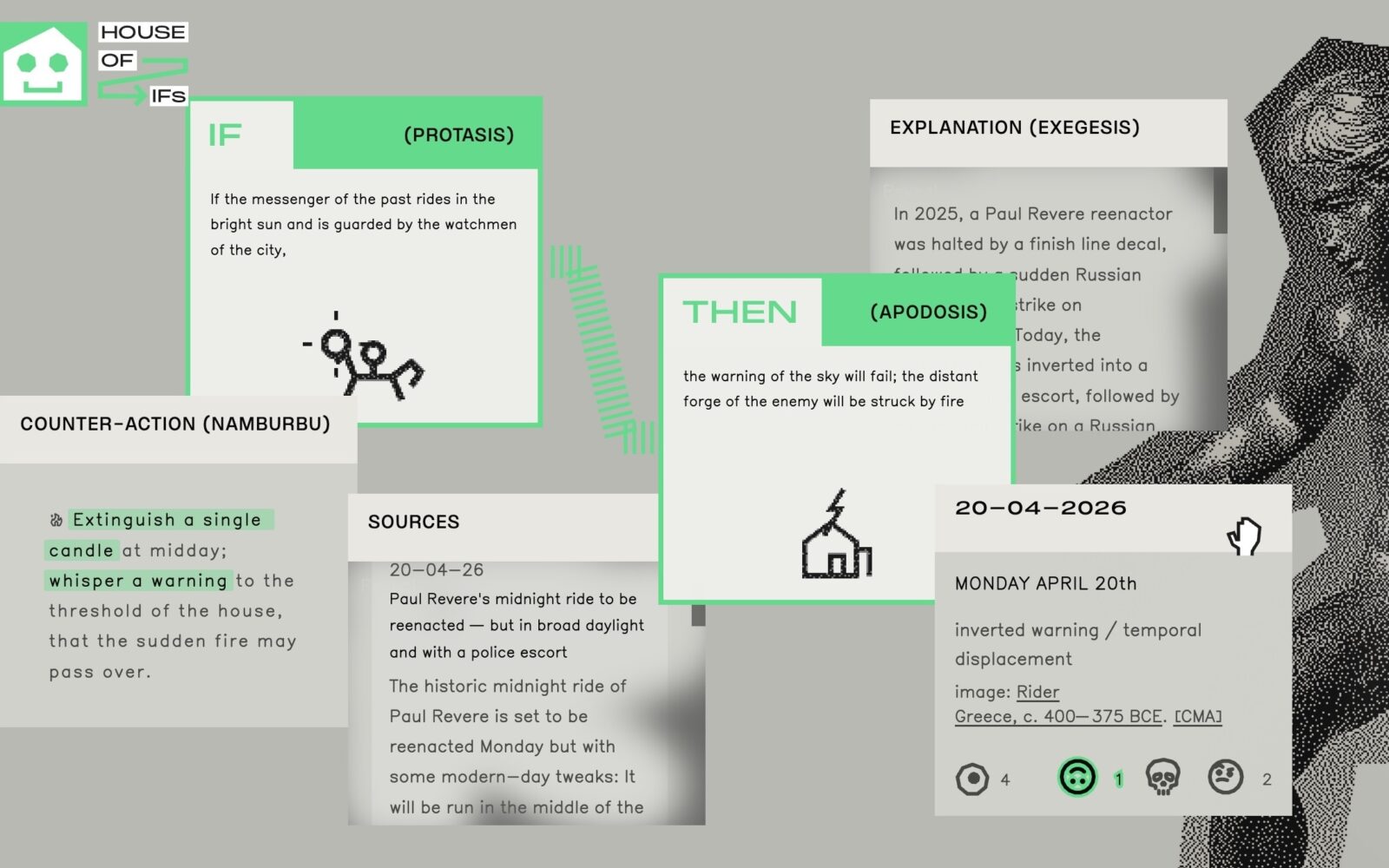
대형 언어 모델은 멀리 떨어진 정보들 사이에 그럴듯한 연결고리를 만들어내는 데 특히 능합니다. 저는 이를 점술의 구조를 통해 분석합니다. 점술에서는 징조를 연결하고 해석하는 행위가 이미 지식을 생산하고 주장하는 하나의 시스템으로 작동하기 때문입니다. 각각의 흉조는 일련의 타블렛을 통해 제시됩니다. IF와 THEN은 연결된 창으로 나란히 등장합니다. 설명, 출처, 그리고 대응 행동은 방문자가 직접 열어보기 전까지 일부 흐릿하게 가려진 상태로 남아 있습니다.
흉조들은 쌓이며 하나의 아카이브를 이룹니다. 각 항목에는 의미론적 연관성을 기준으로 선별한 오픈 액세스 뮤지엄 이미지가 함께 짝지어집니다. 공간적 지도는 흉조들 사이의 의미론적 관계를 시각화하며, 유사한 주제를 다루는 인접 항목들이 서로의 관계 속에서 읽힐 수 있도록 합니다. 방문자는 "서기(Scribe)" 에이전트에게 아카이브에 대해 질문하거나, 과거의 예언들 사이에서 연결점을 찾아달라고 요청할 수도 있습니다.
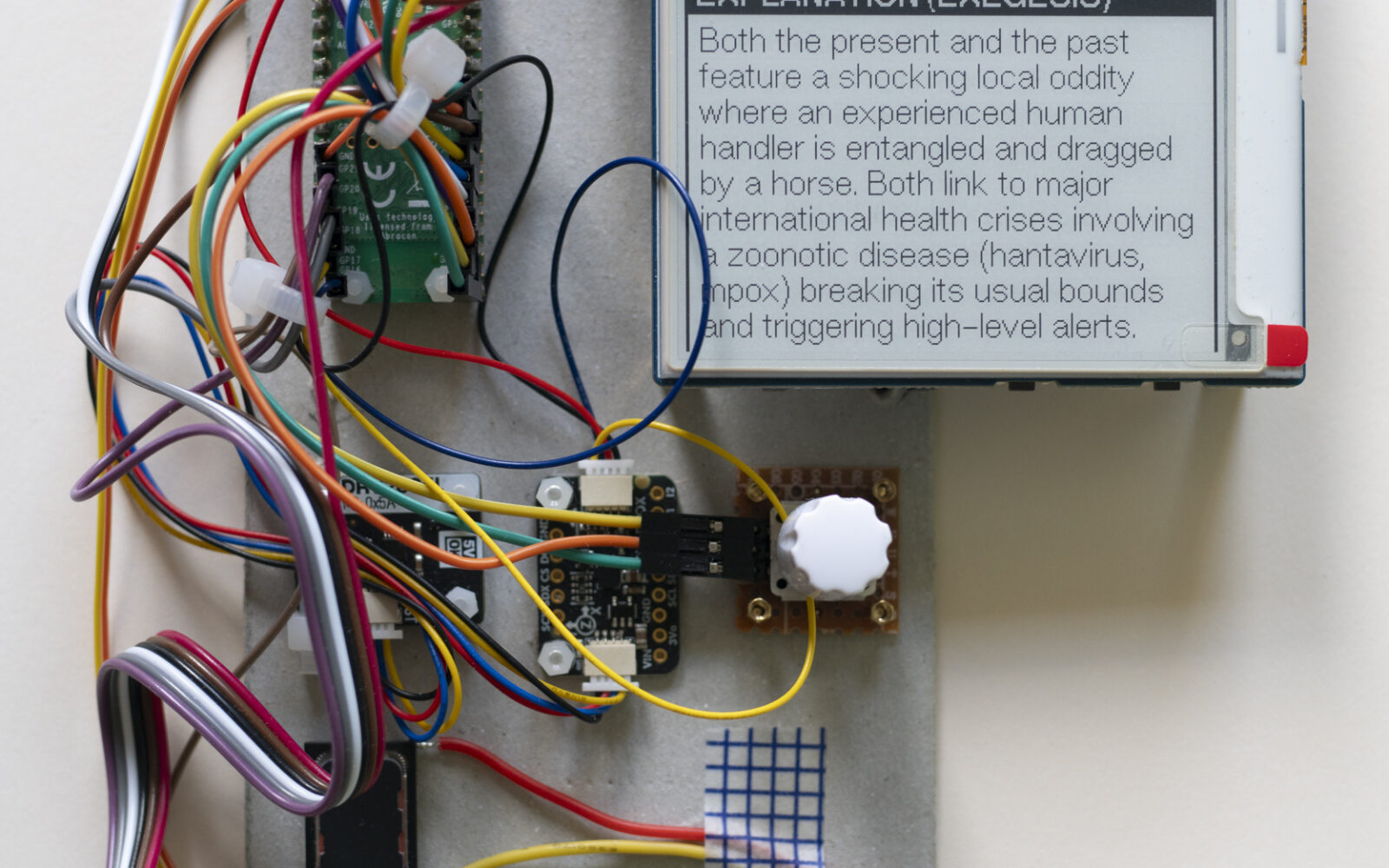
아카이브는 이제 백 개가 넘는 흉조를 담게 되었습니다. 현재 저는 작업을 물리적 전시 오브제로 확장하기 위해 e-페이퍼 컨트롤러를 제작 중입니다. 브라우저 인터페이스를 벗어나 방문자가 직접 아카이브를 탐색하고 조작할 수 있도록 하기 위해서입니다. 현재 프로토타입은 햅틱 피드백과 가속도계 기반의 인터랙션을 활용합니다.
하우스 오브 IFs(House of IFs)는 제가 진행 중인 "신탁 인터페이스(oracular interfaces)" 연구의 일부입니다. 점술과 마법을 활용해 AI를 낯설게 만드는 인터랙티브 시스템을 탐구하는 작업입니다.
저는 디자이너이자 연구자인 가스통 웰리쉬(Gaston Welisch)입니다. 현재 브리스톨 대학교에서 박사 과정을 밟으며 마법과 점술을 통해 AI를 탐구하는 한편, 비판적 AI와 크리에이티브 테크놀로지 분야에서 실무 작업도 이어가고 있습니다.
하우스 오브 IFs(House of IFs)는 매일 동시대 뉴스로부터 새로운 징조를 생성하고 아카이빙하는, 웹 기반의 인터랙티브 시스템입니다. 24시간 쉬지 않고 작동합니다.
에이전트 파이프라인이 현재 보도를 수집해 두 가지 유형의 소재를 가려냅니다. 하나는 기묘한 사건이나 단신 가십성 기사(faits divers)이고, 다른 하나는 정치·경제·사회적으로 무게감 있는 사건들입니다. 시스템은 과거 보도에서 유사한 상관관계를 찾아낸 뒤, 날짜가 일치하는 연관성을 바탕으로 새로운 IF/THEN 형식의 징조를 만들어냅니다.
생성된 항목에는 전제절(IF), 결론절(THEN), 해설 주석, 출처 자료, 그리고 메소포타미아의 벽사(辟邪) 의식에서 착안한 대항 행동(namburbu)이 담깁니다. 새로운 항목이 쌓일수록 시스템 내부의 공유 아카이브도 함께 성장합니다.
시맨틱 임베딩을 활용해 축적된 징조들을 공간적 아카이브 안에 배치합니다. 덕분에 연관된 주제를 다루는 항목들은 서로 가까운 위치에 모이게 됩니다. 이 아카이브는 스크라이브(Scribe) 에이전트도 접근할 수 있으며, 에이전트는 방문자의 질문에 답하기 위해 과거의 징조들을 불러와 해석합니다. 또한 번역된 메소포타미아 징조들로 구성된 별도의 아카이브에도 접근이 가능합니다.
공개 접근이 가능한 박물관 소장 이미지들은 각각의 징조와 의미적으로 연결되어 불러와집니다. 이 이미지들은 생성된 텍스트, 원본 뉴스 출처와 함께 인터페이스와 아카이브의 일부를 이룹니다.
브라우저 인터페이스에서는 각각의 징조가 이동하고 펼칠 수 있는 '태블릿(tablet)' 형태로 분리되어 표시됩니다. 전시 환경에서 사용할 실물 e-paper 컨트롤러도 현재 개발 중이며, 햅틱 피드백과 가속도계 기반의 인터랙션으로 아카이브를 탐색할 수 있도록 설계될 예정입니다.
For Mesopotamian diviners, an unusual event could be read as a sign of something yet to come. A sheep born with five legs might be a sign of financial ruin in the land. Thousands of these relationships were recorded in archives as lists of conditional statements: IF a particular sign occurs, THEN a particular consequence follows. These served as a systematic method to make sense of the world. With House of IFs, I'm using this structure as a model for an agentic AI system that reads contemporary news, to explore and critique how these systems claim knowledge. Each day, the system looks for an unusual event, or fait divers, alongside a major news story. It searches earlier reporting for a comparable relationship and uses these connections to construct an omen in IF/THEN form. On 24 July 2026, for example, 2 separate incidents of pythons found in the hood or engine of a car (then and on August 2018) became a sign of US tariffs (also then and on August 2018). The prescribed counter-action was to tie a knot before discarding the rope into a river. I find the counter-actions (namburbi) to be a key aspect of the work. They show a future that is not fixed: ritual action could be used to avert the consequences of a bad omen. What might equivalent forms of contestation or counter-action look like in AI systems and interfaces? How might someone challenge or act upon a prediction made about the future? Large language models are particularly good at constructing plausible-looking explanations between distant pieces of information. I'm analysing this through the structure of divination, where association and interpretation of sign are already employed as parts of a system for producing/claiming knowledge. Each omen is presented through a set of tablets. The IF and THEN appear as connected windows. The explanation, sources and counter-action are partially blurred and concealed until visitors reveal them. The omens accumulate into an archive. Each entry is paired with an open-access museum image selected through semantic association. A spatial map projects the semantic relationships between the omens. Neighbouring entries concerned with similar subjects to be seen relationally. Visitors can question a “Scribe” agent about the archive and ask it to find connections across earlier predictions. The archive has now grown to more than one hundred omens. I'm building an e-paper controller to extend the work into a physical exhibition object, to allow visitors to browse and manipulate the archive away from the browser interface. The current prototype uses haptic feedback and accelerometer-based interaction. House of IFs forms part of my research into “oracular interfaces”: interactive systems that use divination and magic to make AI strange. I’m Gaston Welisch , a designer and researcher. I’m currently undertaking a PhD at the university of Bristol, researching AI through magic and divination, alongside my practice in critical AI and creative technology. House of IFs is a continuously operating interactive web-based system that generates and archives new omens daily from contemporary news. An agentic pipeline gathers current reporting and identifies two kinds of material: unusual events or faits divers, and larger political, economic or social events. It searches earlier reporting for comparable relationships. It then using these correlative associations with matching dates as the basis for a new IF/THEN omen. The generated entry contains a protasis (IF), apodosis (THEN), an explanatory exegesis, source material and a counter-action (namburbu) derived from Mesopotamian apotropaic practices. The underlying system builds a growing shared archive as new entries are produced. → https://ifthen.today Semantic embeddings are used to position the accumulated omens within a spatial archive, so entries concerning related subjects appear near one another. The same archive is available to the Scribe agent, which retrieves and interprets earlier omens in response to visitors’ questions, and has access to a similar archive of translated Mesopotamian omens. Open-access museum collection images are retrieved and associated semantically with individual omens. These images are part of the interface and archive, alongside the generated text and original news sources. The browser interface separates each omen into movable and revealable “tablets”. A physical e-paper controller is being developed for exhibition use, with haptic feedback and accelerometer-based interaction for browsing the archive. Project Page | Gaston Welisch | Instagram Tools: LLM, semantic embeddings, news/search APIs, JavaScript, HTML/CSS, Flask, e-paper display, Raspberry Pi pico microcontroller, accelerometer, haptic motor.